
Description
MusicWeb International | Jonathan Woolf – March 2026
“Flair and adventure from an Englishman in The Hague.”
—
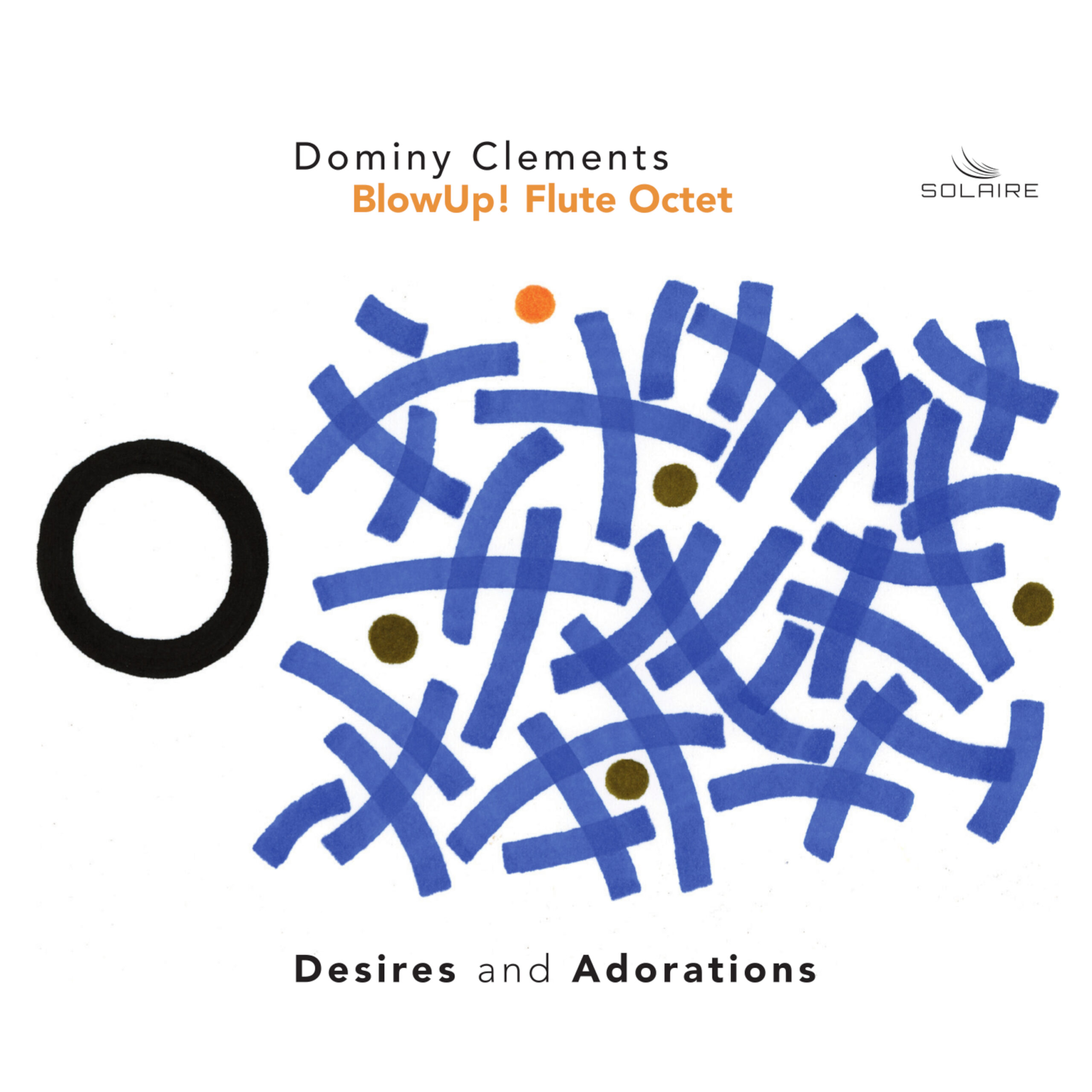
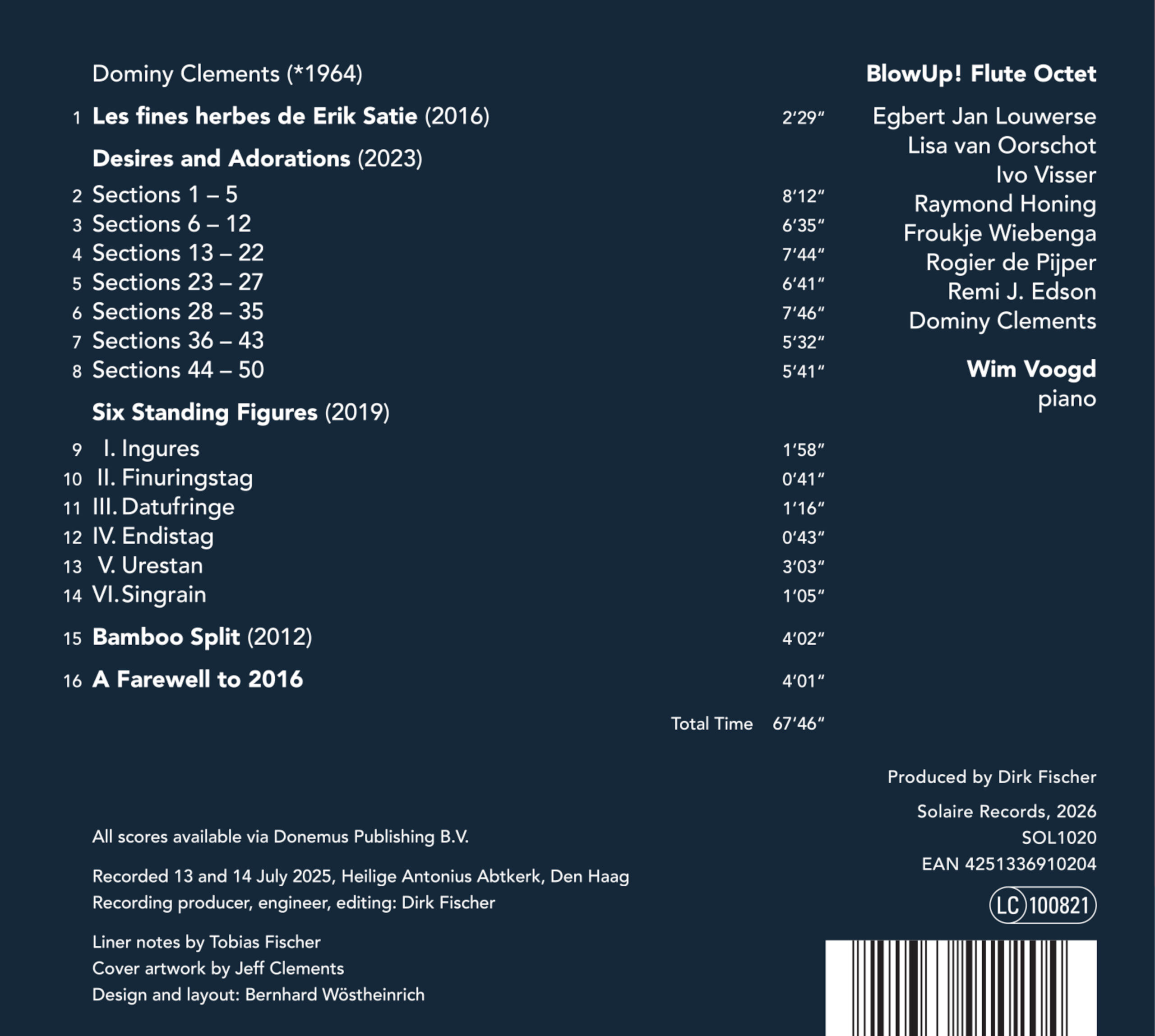
Around 1987, Dominy Clements heard Simeon ten Holt’s minimalist classic Canto Ostinato for the first time. Decades after that important moment, Clements now presents a long-form work inspired by ten Holt. Performed by, but not limited to, an octet of woodwind instruments and piano, Desires and Adorations is a sonic flow-state – pulsing and floating for 45 blissful minutes.
It has taken Clements 40 years to get to this point. Studying under Louis Andriessen, another famous composer of the Dutch minimalism scene, he, initially, found it hard to avoid emulating his predecessors. Later, his style tended towards shorter durations and away from the immersive dimensions of ten Holt – some of these nonetheless striking early pieces can be found on this album. His personal voice emerged when he began shifting his focus. Just like ‘Canto,’ Desires and Adorations is made up of small cells. But everything emerges from a simple chord in 5/8 time – it is rhythmicised harmony.
For producer Dirk Fischer of Solaire Records, hearing ‘Desires’ was a revelation and an obvious fit for the label. He had, previously, released woodwind music by another Dutch composer, Erik Lotichius – also inspired by minimalism – and an album by the Matangi Quartet, whose rendition of ‘Canto Ostinato’ was singled out by the New York Times. He saw a video of BlowUp! performing ‘Desires’ and was hooked immediately: “What Dominy sent me were just excerpts,” he remembers, “But they were enough to draw me in.”
For Solaire’s Tobias Fischer, Clements’s vision, as indebted as it is to ten Holt, manages to create something entirely unique: “You get everything here that made ‘Canto Ostinato’ or Riley’s ‘In C’ so great: The performative flexibility, the rhythmical inventiveness, the constant recombinations. But, then, the music is performed by an ensemble of flutes and a grand piano. And rather than pushing you down, like so much of contemporary bass-heavy music, it creates a state of weightlessness and suspension. It’s literally uplifting.”
Getting the music there was not quite as easy. After the Dutch ‘ten Holt Foundation’ had announced its call for composers to write new music, first ideas came quickly to Clements. But then, the hard work began: “Editing ‘Desires’ after the first draft easily took as long as the initial writing process,” he admits. Since the music was foremost harmony-oriented but allowed performers to find their own path through it, weeding out unwanted dissonance became the main challenge. Ultimately, he resolved the issues by trusting his intuition – and by “avoiding being too clever.”
Which is precisely what the music does as well and why it makes for such a fitting complement to ‘Canto Ostinato’: This is a work that keeps you hooked for its full duration. But it can also be enjoyed by simply disengaging from “the process”, by just listening.


Reviews
There are no reviews yet.